

Every moment of your child’s day is filled with sensory information. The sound of a dog barking. The feeling of socks on their feet. The movement of being picked up. The position of their body as they climb onto the couch. The sensation of a full stomach or the need to use the bathroom.
All of that information has to get somewhere.
Our sensory systems carry information from both inside and outside the body to the brain. The brain then has an important job: it has to interpret that information, determine what is important, and decide how the body should respond.
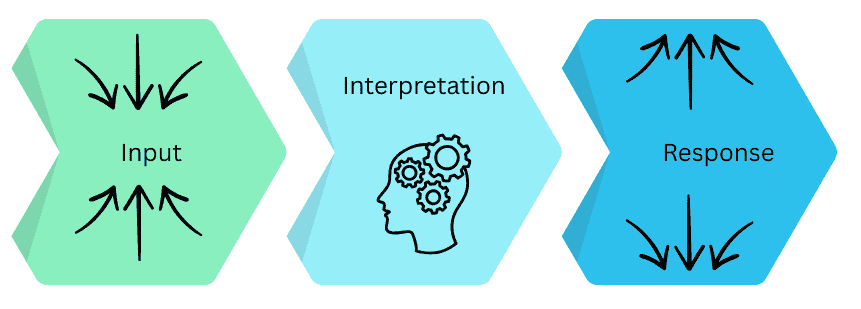
And in a developing child, that process is happening over and over again as the brain learns about the body and the world around it.
October is Sensory Processing Awareness Month. Last year, we introduced the eight sensory systems and talked about what sensory processing differences can look like in children. This year, we’re going a little deeper.
How do these sensory systems actually work together? Why are sensory experiences so important during development? And what can a child’s response to sensory information tell us?
First, a quick refresher: We have more than 5 senses
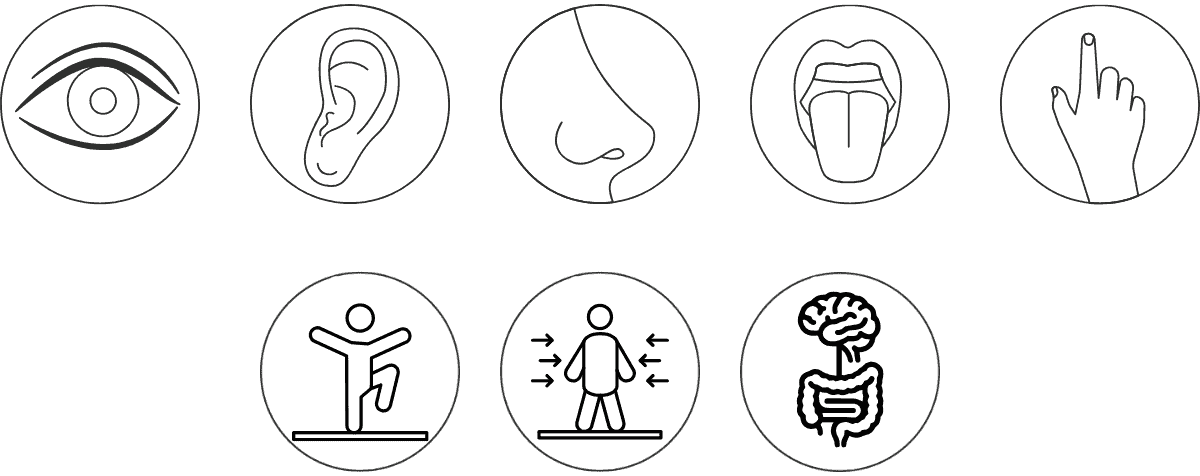
Most of us learned about five senses: sight, hearing, smell, taste and touch.
But there are three additional sensory systems that are incredibly important to development: the vestibular, proprioceptive and interoceptive systems.
One way to think about the eight sensory systems is to divide them into far senses and near senses.
Far senses: information about the world around us
Our far senses include:
- Vision
- Hearing
- Smell
- Taste
- Touch
These systems provide information about what is happening in our environment.
Near senses: information about our own body
The near senses include:
Vestibular: information about movement, gravity, balance and changes in head position.
Proprioception: information from muscles and joints that helps the brain understand where the body is positioned and how much force is being used.
Interoception: information from inside the body, including sensations associated with hunger, thirst, temperature, heart rate, digestion, bladder and bowel needs, and other internal states.
But none of these sensory systems work in isolation. The brain is constantly combining information from multiple senses to understand the body, the environment, and what to do next.
Your brain is constantly putting sensory information together
Imagine standing on one foot.
With your eyes open on a solid floor, this may feel pretty easy. Your visual system can see the room around you. Proprioceptive information from your muscles and joints helps tell your brain where your body is positioned. Your vestibular system provides information about movement and balance.
Now close your eyes.
You may start to wobble.
You haven’t suddenly forgotten how to balance. You simply removed one source of sensory information. Your brain now has to rely more heavily on proprioceptive and vestibular information to keep you upright.
Now imagine trying the same thing on a soft or unstable surface. The information coming from underneath your foot has changed, too.
Your brain has to continually interpret the information available, anticipate changes and make tiny corrections to keep you upright.
Children are doing versions of this all day long.
They are navigating uneven ground, climbing playground equipment, learning to sit, crawl and walk, figuring out stairs, reaching for toys, catching balls and learning increasingly complex movements.
Successful movement isn’t the job of one sensory system. The brain has to combine information from multiple systems and use it to create an appropriate response.
That is an important part of sensory integration.
Sensory experiences help pave the road for development

A baby’s brain is constantly learning. Early experiences provide enormous amounts of information about the body and the environment. Through movement, touch, sound, vision and internal sensations, the developing nervous system begins recognizing patterns and building increasingly efficient responses.
We like to think of development a little like building a road.
Varied, repeated sensory and movement experiences help pave the road. As children practice skills and encounter new experiences, those pathways become more familiar and efficient. New skills can then build upon the foundation underneath them.
For example, think about everything that has to happen for a child to reach for and pick up a toy. Their eyes have to locate the toy and help judge where it is. Their brain needs information about the position of their head, shoulder, arm and hand. Their body has to stay stable while the arm moves, and then the hand has to reach the right distance and use the right amount of force to grasp it. This is visual-motor development—using what we see together with information from the body to guide movement.
The same building process happens as children develop fine motor skills. Before the hands and fingers can efficiently manage more precise tasks like using utensils, manipulating small objects, drawing or eventually writing, children spend a tremendous amount of time developing control of the larger parts of their body. Proximal stability simply means having enough stability and control through the trunk and shoulders to give the arms and hands a steady base from which to work.
Development continues to build on development.
This is one reason we don’t look at developmental milestones as completely isolated skills. We want to understand how a child moves through development, not simply whether they eventually arrive at the next milestone.
Children are also remarkably adaptable.
When one movement or sensory strategy is difficult, the developing brain may find another way to accomplish the task. Sometimes those adaptations are temporary and disappear as skills mature. Other times we begin to notice persistent patterns—such as consistent side preferences, unusual movement strategies, difficulty with certain positions or challenges progressing to the next developmental skill.
Those patterns give us information and help us decide when it may be useful to look a little deeper.
Before self-regulation comes co-regulation
Sensory development isn’t happening in isolation. Especially during infancy and early childhood, children are also learning how to respond to their environment through their interactions with the people caring for them.
Babies aren’t born with an adult’s ability to recognize that they are overwhelmed, calm their bodies and choose a different response. Those skills develop over time.
Early on, regulation happens largely with another person. A familiar voice, responsive facial expressions, predictable touch, being held and rocked, and having a caregiver respond consistently to a baby’s cues all provide sensory and relational information.
Over thousands of everyday interactions, babies begin learning patterns: I’m hungry and someone feeds me. Something startled me and I’m safe again. I became overwhelmed and someone helped me settle.
This is co-regulation, and it helps lay the groundwork for the self-regulation that develops as children mature.
As babies become toddlers and young children, co-regulation starts to look different.
Sometimes our job isn’t to remove every challenge from the environment. It’s to give children a safe foundation from which they can explore it.
Think about a toddler climbing at the playground. We don’t necessarily need to hover over every step or immediately stop them when something looks difficult. When the situation is developmentally appropriate and reasonably safe, we can stay available while allowing them to figure out their body and the environment.
We might ask:
“Does that feel safe?”
“What’s your plan?”
“Where could your foot go next?”
Then we let them try.
Sometimes they succeed. Sometimes they change their plan. Sometimes they stumble or discover that something didn’t work the way they expected.
All of those experiences provide information.
The child is learning about balance, body position, movement, force, distance and their own abilities. Just as importantly, they are learning what it feels like to encounter uncertainty or frustration and recover from it with a trusted adult nearby.
That doesn’t mean allowing unsafe behavior. Adults still provide boundaries and intervene when necessary. But we don’t have to prevent every wobble, mistake or manageable failure either.
Exploration gives the sensory system information. Co-regulation provides a foundation of safety from which children can use that information and gradually develop their own ability to regulate and adapt.
Click HERE for a free parent brain building and bonding guide.
Sensory processing isn’t simply “sensitive” or “not sensitive”
This is where sensory processing becomes more nuanced.
We often hear children described as sensory sensitive, sensory seeking, over-responsive or under-responsive.
Those descriptions can be helpful, but they don’t tell the entire story.
A child’s response to sensory information isn’t necessarily the same every time.
Think about how differently you tolerate noise when you’re rested and relaxed compared with when you’re exhausted, hungry, sick, stressed or already overwhelmed.
Children experience this too.
At any given moment, the nervous system is processing information from many different sources. Sleep, hunger, illness, emotional stress, physical demands, unfamiliar environments and the amount of sensory information arriving at once can all influence how much additional input a child can comfortably process.
We can think of this as regulatory bandwidth.
When there is plenty of bandwidth available, a child may be able to receive sensory information, interpret it and respond without much difficulty.
When the system is already carrying a heavy load, the threshold may be very different.
That’s why the same child may happily participate in a noisy birthday party one weekend and cover their ears or become overwhelmed in a loud environment another day.
The output gives us information—but we have to look at the whole picture.
Over-responsive, under-responsive and sensory-seeking patterns
An over-responsive response occurs when sensory information produces a larger or more protective response than we might expect for the situation.
That might look like covering the ears with certain sounds, strongly avoiding particular textures, becoming distressed with unexpected touch or avoiding certain types of movement.
An under-responsive child may need stronger or more noticeable input before the nervous system registers or responds to the information.
And a sensory-seeking child may actively create additional sensory experiences—jumping, crashing, spinning, pushing, chewing, climbing or seeking deep pressure and movement.
Sometimes that additional input provides clearer information about the body and environment.
And here’s an important piece:
The same child can seek one kind of sensory information while avoiding another.
A child who loves big squeezes and crashes into the couch may dislike unexpected light touch. Those behaviors aren’t necessarily contradictory.
Deep pressure and proprioceptive input can provide strong, predictable information about where the body is. Light or unexpected touch provides very different information and may be harder for that child’s nervous system to interpret.
Instead of immediately asking whether a sensory response is “good” or “bad,” it can be more useful to ask:
What information is coming in? How is the child responding? And is there a pattern?
Behavior can give us clues
A child’s behavior is one piece of information about what their nervous system may be experiencing.
Imagine a child who consistently avoids certain playground equipment. They may happily run around the playground but refuse the swings, hesitate on a wobbly bridge or become uncomfortable when their feet leave the ground.
They may simply not like that activity. But we can also get curious.
How does the child respond to movement in other situations? Are they comfortable climbing when their feet and hands feel firmly supported? Do they avoid unpredictable movement but enjoy running and jumping on solid ground? Do they seek other kinds of movement or pressure?
One observation doesn’t give us the answer.
Patterns matter.
When we evaluate children, we pay attention to much more than whether they can complete a particular task. We watch how they sit and stand, how they move through the room, how they interact with toys, how they respond to different positions and sensory input, whether movement is symmetrical and fluid, and how easily they adapt when something becomes challenging or unfamiliar.
In infants, we may notice persistent head or body preferences, consistently rolling in one direction, differences in movement quality or difficulty progressing through expected developmental skills.
In older children, patterns may show up through posture, balance, coordination, movement preferences, fidgeting, sensory-seeking behaviors, avoidance of certain activities or difficulty adapting to changing sensory demands.
None of these observations alone means that a child has a sensory processing disorder.
They are clues that help us ask better questions.
Supporting the whole child
Sensory processing is complex, and there isn’t one profession or one treatment that addresses every piece of it.
Depending on what a child is experiencing, their care team might include their pediatrician, occupational therapist, physical therapist, feeding therapist, vision provider, chiropractor or other pediatric specialists.
Our role at Radiant Family Wellness is to look at the whole developmental picture. During pediatric examinations, we consider movement quality, posture, balance, developmental milestones, sensory-motor responses and how comfortably and efficiently a child is using their body.
Chiropractic care itself also provides sensory information. Gentle touch, pressure and movement during an adjustment create input that the nervous system receives alongside all of the other sensory information a child experiences throughout the day. We consider that input as one piece of a much larger developmental picture—not as a replacement for the movement, play, relationships, therapies or everyday sensory experiences that help a child learn about their body and environment.
When something falls outside our scope or a child would benefit from additional evaluation, collaboration with other pediatric providers is an important part of care.
Sensory processing is happening all the time
Your child’s nervous system is constantly receiving information.
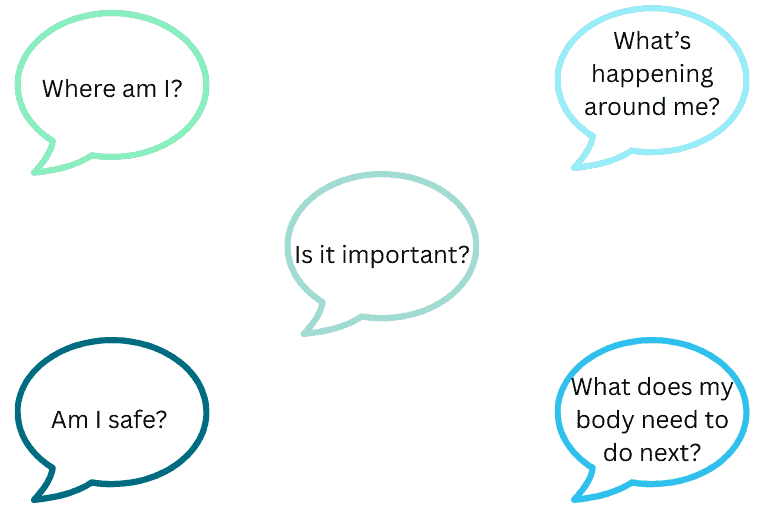
From an infant learning to control their head to an older child navigating a playground, classroom or soccer field, sensory information helps the brain understand the body and the environment—and decide how to respond.
Those experiences become part of the foundation upon which increasingly complex movement, regulation, learning and development are built.
So when we notice an unusual response, persistent movement pattern or sensory preference, we don’t necessarily need to immediately label it as good or bad.
Sometimes the most useful first step is simply to get curious:
What information might this child’s nervous system be giving us?
Noticing a pattern in your child?
You know your child best. If you’ve noticed consistent patterns in the way they move, play, respond to sensory experiences or navigate everyday activities, those observations are worth sharing. Your child’s pediatrician, occupational therapist, physical therapist, chiropractor or other members of their care team can help determine whether those patterns are simply part of their individual development or deserve a closer look.
If you have questions about something you’re noticing with your child, we’re always happy to be part of that conversation. Reach out to us at Radiant Family Wellness to ask a question, learn more about how we work with children, or schedule a visit.